


Javanese civilisation has been influenced by more than a millennium of interactions between the native animism Kejawèn and the Indian Hindu—Buddhist culture, and this influence is still visible in Javanese history, culture, traditions, and art forms. The ancient Javanese kingdoms of Singhasari and Majapahit were among the most powerful maritime empires in the region, whose boundaries included most of Maritime Southeast Asia and parts of Indoch
Javanese heritage has created magnificent religious monuments such as Borobudur and Prambanan which are among the world's largest temples. Javanese culture has a strong influence in most of the Southeast Asian countries. In Brunei, Malaysia, and Singapore, the influence of Javanese culture can be seen in many aspects of modern Malay culture. Javanese culture has greatly influenced their traditional cuisine with many dishes such as satay, sambal, ketupat, nasi kuning (pulut kuning), and rojak. Kris weaponry, batik and ronggeng dance art, gamelan musical instruments, and wayang kulit puppetry. introduced to them through Javanese contact. Javanese culture has also spread widely beyond Southeast Asia to countries such as Sri Lanka, South Africa, and Suriname, where many of the Javanese diaspora live.


Balinese
Bali is the only Hindu-majority province in Indonesia, with 86.40% of the population adhering to Balinese Hinduism.It is renowned for its highly developed arts, including traditional and modern dance, sculpture, painting, leather, metalworking, and music. The Indonesian International Film Festival is held every year in Bali. Other international events that have been held in Bali include Miss World 2013, the 2018 Annual Meetings of the International Monetary Fund and the World Bank Group, and the 2022 G20 summit. In March 2017, Tripadvisor named Bali as the world's top destination in its Traveler's Choice award, which it earned once again in January 2021 and 2026.
Bali is part of the Coral Triangle, an area with high diversity of marine species, mainly fish and turtles. In this area alone, over 500 reef-building coral species can be found. For comparison, this is about seven times as many as in the entire Caribbean. Bali is the home of the Subak irrigation system, a UNESCO World Heritage Site. It is also home to a unified confederation of kingdoms composed of 10 traditional royal Balinese houses, each house ruling a specific geographic area. The confederation is the successor of the Bali Kingdom. The royal houses, which originated before Dutch colonisation, are not recognised by the government of Indonesia.


The Ijen volcano complex is a group of composite volcanoes located on the border between Banyuwangi Regency and Bondowoso Regency of East Java, Indonesia. It is known for its blue fire, acidic crater lake, and labour-intensive sulfur mining.
It is inside an eponymous larger caldera Ijen, which is about 20 kilometres (12 mi) wide. The Gunung Merapi stratovolcano is the highest point of that complex. The name "Gunung Merapi" means 'mountain of fire' in the Indonesian language; Mount Merapi in central Java and Marapi in Sumatra have the same etymology.
Ijen Geopark stretches across the entire regency which is specifically in the Mount Ijen area, Pulau Merah Beach, and Alas Purwo National Park. It has various geological, biological, and cultural sites. It became part of UNESCO Global Geoparks in 2023.
West of Gunung Merapi is the Ijen volcano, which has a one-kilometre-wide (0.62 mi) turquoise-coloured acidic crater lake. The lake is the site of a labour-intensive sulfur mining operation, in which sulfur-laden baskets are carried by hand from the crater floor. The work is paid well considering the cost of living in the area, but is very onerous. Workers earn around US$13 per day and, once out of the crater, still need to carry their loads of sulfur chunks about three kilometers to the nearby Paltuding Valley to get paid.
Many other post-caldera cones and craters are located within the caldera or along its rim. The largest concentration of post-caldera cones runs east–west across the southern side of the caldera. The active crater at Kawah Ijen has a diameter of 722 metres (2,369 ft) and a surface area of 0.41 square kilometres (0.16 sq mi). It is 200 metres (660 ft) deep and has a volume of 36 cubic hectometres (29,000 acre⋅ft).
The lake is recognised as the largest highly acidic crater lake in the world. It is also a source for the river Banyupahit, resulting in highly acidic and metal-enriched river water which has a significant detrimental effect on the downstream river ecosystem. During a scientific expedition in 2001, the pH of the lake was measured at <0.3. On 14–15 July 2008, explorer George Kourounis took a small rubber boat out onto the acid lake to measure its acidity. The pH of the water at the lake's edges was measured to be 0.5 and in the middle of the lake 0.13 due to a high concentration of sulfuric acid.


IJEN CRATER
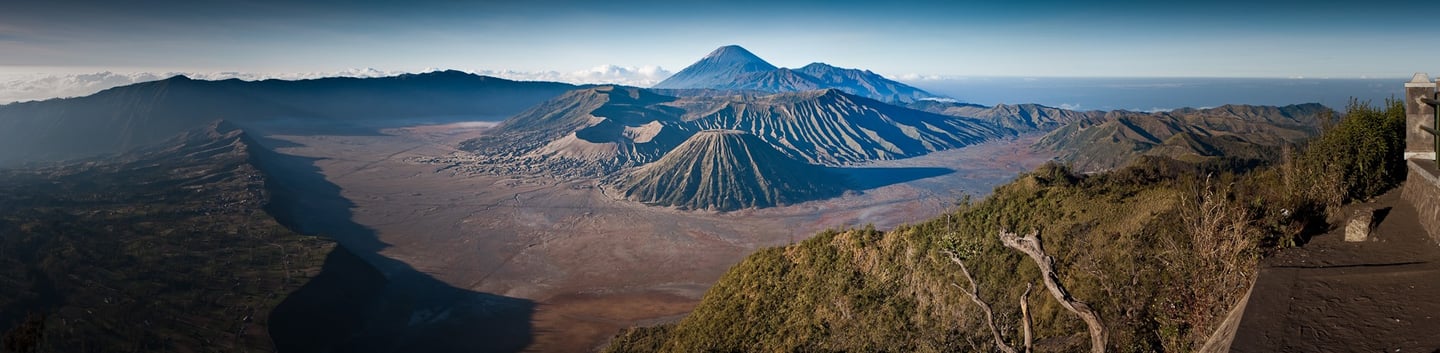
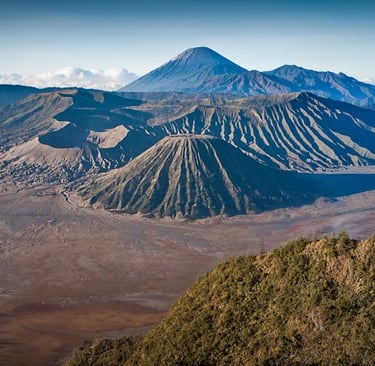
On the fourteenth day of the Hindu festival of Yadnya Kasada, the Tenggerese people of Probolinggo Regency, East Java, travel up the mountain in order to make offerings of fruit, rice, vegetables, flowers and sacrifices of livestock to the mountain gods by throwing them into the caldera of the volcano. The origin of the ritual lies in the 15th century legend. On the sand plain, locally called Segara Wedi (lit. sand ocean), sits a Hindu temple called Pura Luhur Poten. The temple holds a significant importance to the Tenggerese scattered across the mountain villages, such as Ngadisari, Wonokitri, Ngadas, Argosari, Ranu Prani, Ledok Ombo and Wonokerso. The temple organises the annual Yadnya Kasada ceremony which lasts for about one month. The major difference between this temple and Balinese ones are the type of stones and building materials. Pura Luhur Poten uses natural black stones from volcanoes nearby, while Balinese temples are mostly made from red bricks. Inside this pura, there are several buildings and enclosures aligned in a mandala zone composition.